
Power-Hungry AI

AI is power-hungry in the sense of needing lots of electricity. In the future AI may also want to dominate humans – CEO of OpenAI Sam Altman says they now know how to build Artificial General Intelligence so perhaps sooner than we would like. However, the immediate challenge is generating enough electricity to meet growing AI power demands.
I was listening to a podcast about the need for energy in the context of Google searches vs ChatGPT searches. There's a figure widely bandied around the internet and social media that a ChatGPT search uses about ten times as much energy as a Google search. The podcast participants were discussing the truth of this statement and what they used ChatGPT, or other large language models for.
One participant said, "I use ChatGPT to answer questions like, 'How old is Catherine Zeta-Jones.'"
Another participant pointed out ChatGPT could return a correct answer, or a completely erroneous one, as ChatGPT doesn't look the information up but predicts the appropriate words based on its training of the order words are found in on the internet. I wrote about my frustration with people's lack of understanding of how LLMs work and misinformation produced in AI Influence.
The first participant said, "I don't care whether the ChatGPT answer is correct." I could fulminate on why someone would search for information when they don't care if the answer is right...
Anyhow, is it true a ChatGPT search uses way more energy than a Google search? It looks like this information is way out of date. In 2011, a Google search used around 0.3 watt hours (Wh) – about 5 minutes of a standard LED ceiling light). Now, a Google search uses around 0.6-0.7Wh. In contrast, a ChatGPT search is calculated to use around 0.5Wh.
That's not the whole story, however. LLMs need to be trained. Training ChatGPT-3 required 1287 megawatt hours (MWh) of electricity – this would run an average NZ household for 181 years (although our houses don't last that long). How many queries does the training of an LLM gets spread across? I doubt anyone could answer that. What I do know is the need for LLM training will proliferate, as LLMs are being developed for specific purposes. For example, I have worked on a proposal to develop an LLM to write reports about environmental monitoring for the NZ Ministry of Primary Industries. I also know chips are likely to become more efficient – I have worked on a proposal to develop new materials which will reduce the power required for computation and increase the speed of computation in a chip. So LLM searches will require ongoing increased power for training but less power to run. This makes it hard to come up with an answer to which searches are more energy intensive.
Perhaps the easiest way to determine whether AI is power hungry is on the basis of AI industry power usage and trends. Microsoft is buying pumpkin farms in Wisconsin to build a data centre for AI computing. Microsoft and OpenAI (maker of ChatGPT) have talked about five linked data centres – the Wisconsin facility plus California, Texas, Virginia and Brazil. These five would constitute a massive supercomputer called Stargate which could ultimately require five gigawatts (GW) of electricity annually. New Zealand uses 39GWh of electricity each year. A recent report by Goldman Sachs forecasts data centres could consume 8% of all US electricity in 2030, up from 3% at present. This would be around 0.4 terawatt hours (TWh), that's about ten times New Zealand's current annual power usage.
Given the massive need for more power, big tech companies are looking to nuclear as the only 'clean' option they can rapidly upscale. They are reviving and increasing the size of old nuclear plants and building new plants. Forecasts are the US needs the equivalent of 34 new, full size nuclear power plants by 2030. How they might achieve this is unclear, given it is typically taking 11-12 years for nuclear power plants to be built and commissioned.
Google has just signed up with Kairos Power to install small modular reactors (SMRs), although SMRs are a nascent technology with only 3 built in the world (two in Russia of 35MWe (megawatts of electricity) and one in China of 217MWe). The advantage of SMRs is that they are modular i.e. can be factory-assembled and transported as a unit to the site for installation rather than standard nuclear reactors all being bespoke builds. They are smaller than standard nuclear facilities e.g. the Taiwan nuclear plant in the picture above is 1900MW while SMRs generate up to 300MW. That would mean the US needs around 200 new SMRs by 2030 to supply the forecast increased power demand.
SMRs have a number of advantages compared with 'standard' nuclear reactors:
- They are modular i.e. can be factory-assembled and transported as a unit to the site for installation. This makes them quicker and cheaper to build.
- They are simpler and have more inherent safety factors i.e. they are less likely to overheat in the event of a malfunction.
- They require less water for cooling.
- They need less fuel and to be refuelled less often, meaning spent fuel needs to be handled less often.
More than 80 commercial designs for SMRs are being developed around the world for different applications. The biggest barrier to their implementation is that no one knows how economic they will be once installed. Nuclear power is seen as 'clean' in that nuclear plants don't produce climate warming gases during operation. Over its life cycle, nuclear is estimated to produce about the same amount of climate-warming gases per unit of energy as wind and one third of the emissions compared with solar. These emissions are produced during construction, maintenance and removal of facilities at end of life.
However, nuclear 'cleanness' ignores the risks in nuclear power:
– of nuclear power plants malfunctioning and poisoning the environment with nuclear waste
– of storing spent nuclear fuel somewhere it doesn't contaminate our environment, given it is dangerous for millenia
– of spent nuclear fuel being used for bombs.
I spent my childhood being terrified of the threat of nuclear waste and warfare. This threat appears to be back in the name of advancement.
"What has been will be again; what has been done will be done again; there is nothing new under the sun."
Ecclesiastes 1:9
Is the Bible more or less reliable than ChatGPT?
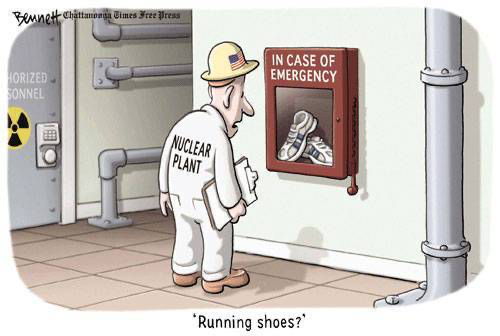

The cartoon may not be entirely accurate - the picture is of safety shoes on display at the Taiwan nuclear plant. I like that safety shoes are red.
Get new content delivered
directly to your inbox.
Latest Posts