
Trigger Warnings

At one of the open mics I attend, it is now commonplace for people to provide ‘trigger warnings’ before they sing a song. One of the participants got up and said he was triggered by trigger warnings so he wasn’t going to provide them. The way ‘trigger’ was being used, it seemed like people were simply referring to content that might result in a negative emotional reaction. I decided I had better look the term up to get a better understanding before I went down my own track of being triggered by the term trigger.
‘Triggers’ have been referred to shortly after there were handguns with levers to pull which make them explode a bullet out of the chamber (handguns were invented around 1570 in Europe). ‘Trigger’ is documented from the 1650s and was derived from the Dutch ‘trekker’, which meant ‘to pull’.
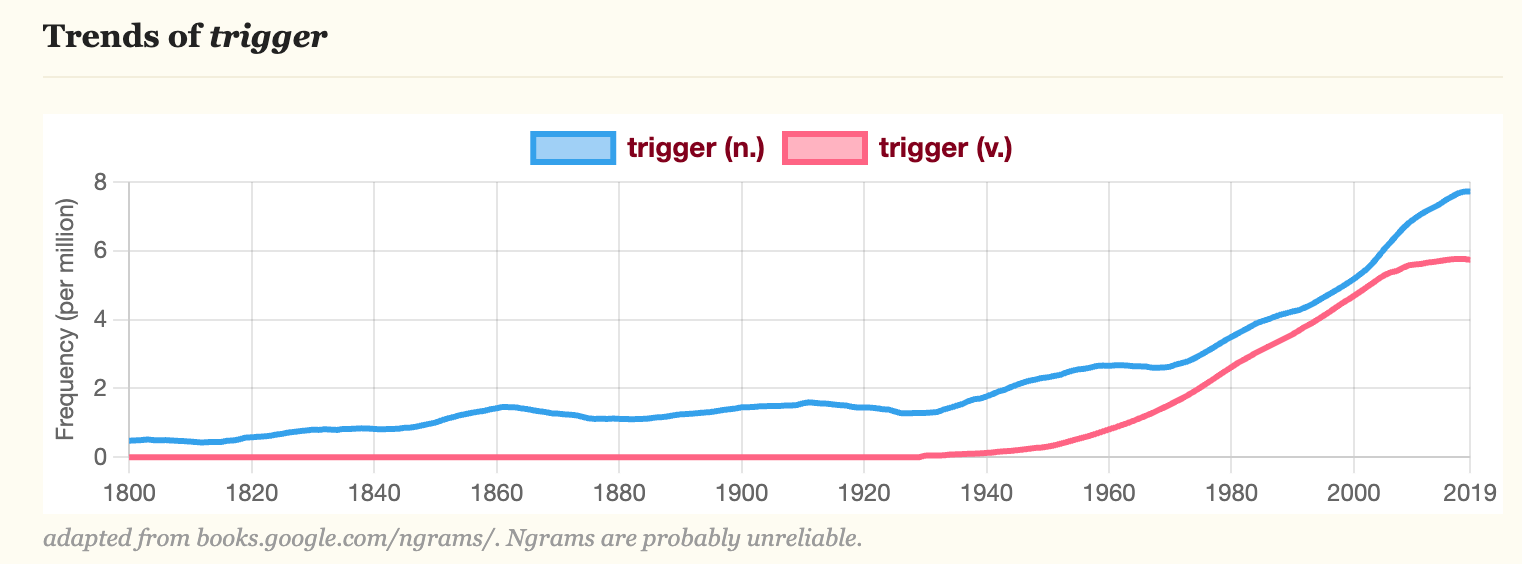
Around 1930, 'trigger' acquired the additional meaning of ‘make something happen’. The use of ‘trigger’ to be the cause of an intense and usually negative emotional reaction is documented from 1986. A 'trigger warning' is a statement intended to assist individuals prepare for or avoid particular content.
Early usage of 'trigger warning' was in feminist messaging forums on the internet to help readers prepare for or avoid memories likely to remind them of trauma, particularly sexual assault. The use of trigger warnings has expanded widely in the 2000s, particularly in Universities. Now they are prevalent across media (and at open mics!) and cover a much wider range of experiences, including being a member of a historically marginalised group and even microaggressions or teasing.
The use of 'trigger' has apparently risen over time although I note that the figure has its own warning – that the method used to come up with this trend (ngrams) is probably unreliable!
Reading the etymology of trigger made it clear to me why I find the use of ‘trigger warning’ so annoying. The phrase has shifted from referring to something significant – the potential to create a significant and painful emotional reaction in someone – to referring to a relatively trivial event. This feels related to the infantilising of society – we need to be warned of risk at every turn and if one person dies carrying out an activity we may all be banned from doing it e.g. the recent accident on Muriwai Beach where a young person died in a car crash and there's a proposal to ban all cars fromthe beach (I’m actually all for banning cars on beaches because of the separation from and damage to the environment they create, but that’s another topic).
We are, at least theoretically, being mollycoddled every step of the way – one might think humans are such poor fragile things that it’s amazing we made it out of the caves rather than curling up and dying of terror when we looked out the cave opening at the scary world beyond. We are creating an environment that protects us from hard physical work (through use of technology), physical risk, from hard mental work, from direct social interaction (social media) and emotional hard work/risk – trigger warnings.
On the emotional hard work front – when I was thinking about a topic for this blog, Chris talked about the funeral he went to this week. He recounted how good it was to be at such a gathering. Even though the farewell ceremony itself was painful there was a huge amount of gain from the connections reinforced and refound when over a hundred people joined together in honour of someone they cared for. In contrast, ubiquitous trigger warnings appear to be telling us that we can avoid circumstances in which we will experience emotional pain and potentially suggest we should avoid them – should funerals have trigger warnings?
If I take a step back and stop reacting to the trigger (or at least the irritation), are trigger warnings even effective? A meta-analysis of all the studies done on trigger warnings suggests otherwise(noting there are relatively few studies and they all focus on Western society). The meta-analysis looked at the effect of trigger warnings on:
- Responses to negative material
- Avoidance of negative material
- Anticipatory effect i.e. what the experience of reading the trigger warning was, outside of the actual material.
The study found:
- Trigger warnings had little effect on people’s responses to the material they read or saw. In other words, trigger warnings don’t help people deal with negative material. This isn’t very surprising – trigger warnings contain nothing that assists someone to manage their experience of the material they are about to encounter. Unless people have developed a coping strategy which they engage upon reading a trigger warning, the warning itself doesn’t help.
- Trigger warnings may either have no effect on whether people view potentially triggering material, or may increase people’s likelihood to look at negative material. Put another way, trigger warnings will not help people deliberately avoid a triggering experience and may even encourage them to have such an experience.
- Trigger warnings have a negative anticipatory effect – the very reading of a trigger warning upsets people.
Limitations of the study are:
- It did not cover multiple exposures to triggering situations overa longer time period.
- It did not consider effects in subpopulations, cultures or context of the experience.
If this meta analysis of existing data is to be believed there is no good evidence for use of trigger warnings. I’ll remember to point that out at my next open mic. Or perhaps I won’t – the study's final conclusion was that use of trigger warnings is enaction of shared cultural concept. I wouldn’t want to appear culturally ignorant at an open mic!
Get new content delivered
directly to your inbox.
Latest Posts